What Are the Differences Between Cuplock and Ringlock Scaffolding Systems
2025-07-11
What Are the Differences Between Cuplock and Ringlock Scaffolding Systems
In the construction industry, scaffolding systems play a crucial role in ensuring both efficiency and safety on job sites. With a variety of scaffolding types available, many professionals often ask: how many types of scaffolding systems exist, and which one best suits their specific project needs? Among the most popular are the Cuplock and Ringlock scaffolding systems, each offering unique advantages for different applications. Understanding the differences between these two systems can help you make an informed decision for your next construction project.
What Is Cuplock Scaffolding System?
The Cuplock scaffolding system is widely recognized for its simple yet robust design. It consists of vertical standards, horizontal ledgers, and specially designed top and bottom cups that lock the components together securely without the need for additional fasteners. This innovative locking mechanism enables quick assembly and disassembly, significantly saving time on site.
Cuplock scaffolding is known for its excellent load-bearing capacity, making it suitable for heavy-duty construction projects such as bridges, high-rise buildings, and industrial facilities. Its modular design allows for flexible configurations, accommodating various structural requirements while maintaining high safety standards.

What Is Ringlock Scaffolding?
The Ringlock scaffolding system is a modular and versatile solution characterized by its unique rosette design, a circular node welded onto the vertical standards. This rosette features multiple openings where horizontal and diagonal components can be securely locked in place using wedges, allowing for flexible and stable construction of scaffolding structures.
Ringlock scaffolding offers exceptional adaptability, making it ideal for complex architectural projects where custom configurations are needed. Its ease of use, combined with strong safety features, makes it a preferred choice for many contractors working on diverse construction sites, including residential buildings, commercial complexes, and industrial plants.
Cuplock vs Ringlock Scaffolding: Comprehensive Comparison
Structural Design and Locking Method
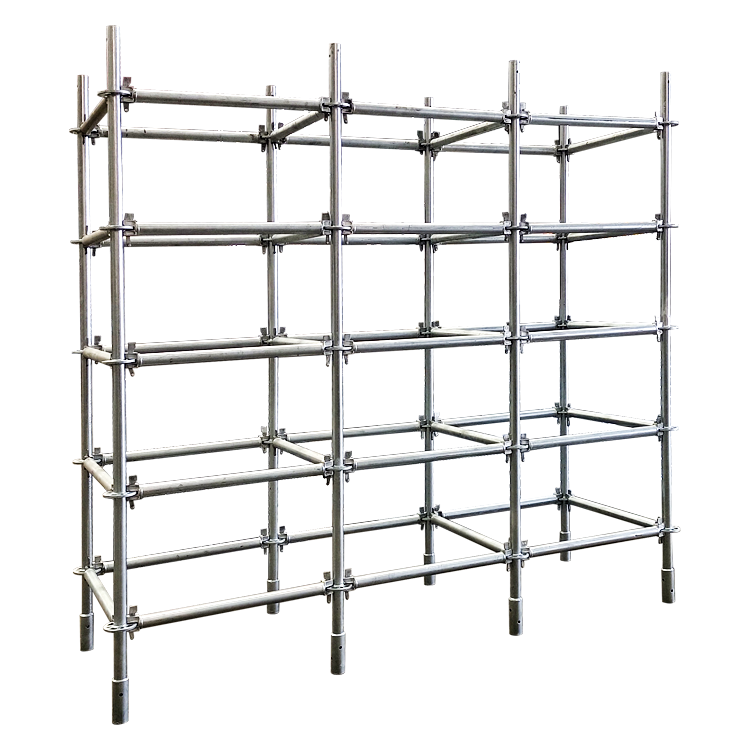
Cuplock: This system employs a unique cup-and-blade locking design. Vertical posts are equipped with metal cups spaced every 500mm, while horizontal bars have blade-like ends that slot into these cups and are secured by twisting the top cup. Each cup anchors components in four directions.
Ringlock: Utilizes a rosette-and-wedge mechanism where circular discs (rosettes) are fixed to vertical posts at 500mm intervals. Horizontal and diagonal braces attach to the rosette slots using wedges, which are hammered into place, allowing connections in eight directions.
Speed and Simplicity of Assembly
Cuplock: Generally faster than traditional clamp systems, but assembling it requires more physical effort compared to Ringlock.
Ringlock: Thanks to its wedge-lock system, this scaffolding is quicker to put together and take apart, making it especially suitable for time-sensitive projects.
Adaptability and Use Cases
Cuplock: Well-suited for straightforward structures such as residential homes, mid-sized commercial buildings, and standard infrastructure projects.
Ringlock: Due to the versatile rosette design, it can accommodate more complex architectural forms like skyscrapers, bridges, tunnels, and large-scale industrial plants.
Load-Bearing Capabilities
Cuplock: Supports loads reliably through four-direction fixation, ideal for typical construction tasks including formwork.
Ringlock: With eight-direction fixing points, it offers enhanced stability and can bear heavier weights more effectively.
Typical Applications
Cuplock: Commonly used for building facades, temporary supports, and straightforward scaffolding setups.
Ringlock: Favored for industrial construction, bridge projects, and situations demanding intricate scaffolding shapes.
Cost Efficiency
Cuplock: More budget-friendly initially, especially when standard scaffold configurations suffice.
Ringlock: Although pricier upfront, it compensates with savings in labor and maintenance over the long term.
Safety Features
Cuplock: Provides solid stability, but since top cups must be manually secured, improper locking can present risks.
Ringlock: Its wedge-lock system ensures connections are firm and secure, offering an extra margin of safety.
Longevity and Upkeep
Cuplock: Typically constructed from galvanized or painted steel that needs routine upkeep to avoid corrosion.
Ringlock: Usually hot-dip galvanized, giving it superior resistance to rust and extending its lifespan.
Logistics: Storage and Transport
Cuplock: Vertical members with cups on both ends tend to occupy more space and require careful handling.
Ringlock: More compact due to rosette-only verticals, facilitating easier storage and shipping.
Training and Labor
Cuplock: Workers must be trained in the cup-and-blade locking technique to ensure safe assembly.
Ringlock: Its straightforward rosette-and-wedge design simplifies training and reduces the skill level required.
Compliance with Regulations
Cuplock: Accepted in many regions but may fall short of stringent safety standards in some high-risk industrial environments.
Ringlock: Often the preferred choice for projects with demanding safety regulations, such as bridges and heavy industrial constructions.