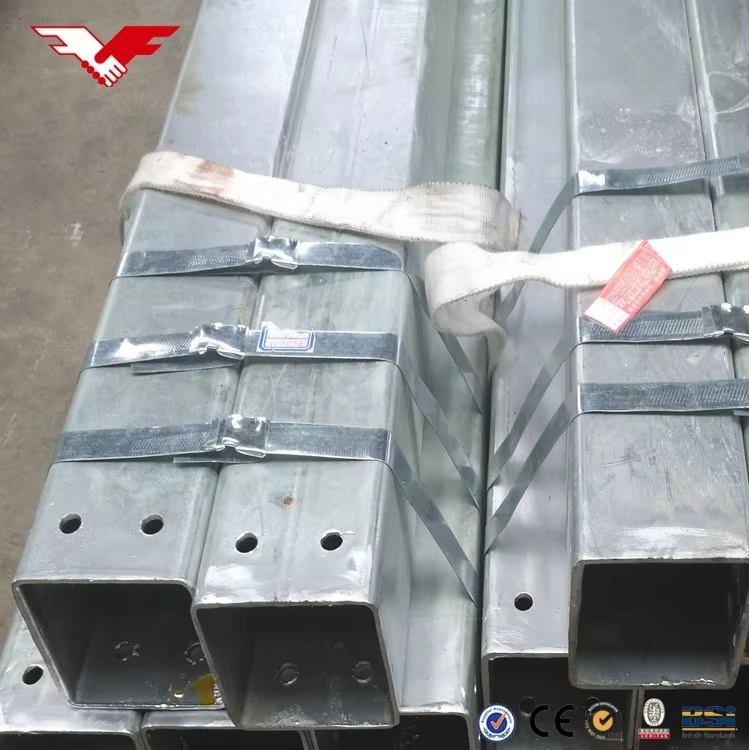
ASTM A53 GR.B API 5L ERW Welded Carbon Steel Pipe MS Pipe For Construction


ASTM A53 GR.B API 5L ERW Welded Carbon Steel Pipe MS Pipe For Construction
ERW
FOB
5tons
Tianjin,China
20Day
API 5L ERW ( Electric Resistance Welded ) steel pipes are designed for transporting oil, gas, and water. Manufactured according to API standards, these pipes are welded along the seam, ensuring strength and reliability. ERW pipes are available in various sizes and grades, making them suitable for both low- and high-pressure applications in the energy sector.
Quantity

What Is ERW Steel Pipe?
ERW steel pipe(Electric Resistance Welded Pipe) is a type of pipe that is manufactured by cold-forming a sheet of steel into a cylindrical shape. The longitudinal seam is then welded using electrical resistance to heat and bond the edges together.
Firstly, form the steel plate or coil into a cylindrical shape. Then the edges of the cylinder are heated using resistance. Finally, apply pressure to forge the edges together, forming a weld seam.
ERW pipes have high strength and durability due to the consistent weld seam.They can withstand high pressure and are suitable for transporting fluids and gases.
The production process of ERW steel pipes is efficient and economical, with uniform wall thickness and smooth surface, and can produce various sizes and lengths. Widely used in oil and gas transportation, water supply systems, and structural applications. Also used in the automotive and engineering industries.
ERW Steel Pipe Product Detail
| Product | Electric Resistance Welded Pipe / ERW Carbon Steel Pipe |
| Brand | Youfa ERW Carbon Steel Pipe Manufacturer |
| Material | Carbon Steel |
| Length | 1-12m |
| Grade | Q195=S195/A53 Grade A |
| Q235=S235/A53 Grade B/A500 Grade A/STK400/SS400/ST42.2 | |
| Q345=S355JR/A500 Grade B Grade C | |
| Standard | DIN 2440,ISO 65,EN10255,BS1387,GB/T3091,GB/T13793, |
| JIS 3444/3466,API 5L,A500,A36,ASTM A795,ASTM A53 GR B ERW | |
| Surface | Bare/Natural Black |
| Ends | Plain Ends |
| With or Without Caps | |
| FOB Port | Tianjin Port |
| Terms of Payment | L/C,T/T |
| Outside Diameter | Wall Thickness | ||
| DN | Inch | mm | mm |
| 15 | 1/2” | 20~21.3 | 0.95~2.77 |
| 20 | 3/4” | 25~26.9 | 1.1~2.87 |
| 25 | 1” | 32~33.7 | 1.1~4.0 |
| 32 | 1 1/4” | 40~42.4 | 1.5~4.0 |
| 40 | 1 1/2” | 47~48.3 | 1.8~7.0 |
| 50 | 2” | 58~60.3 | 2.0~7.0 |
| 65 | 2 1/2” | 73~76.1 | 2.2~7.0 |
| 80 | 3” | 87~88.9 | 2.2~8.0 |
| 90 | 3 1/2” | 101.6~102.1 | 2.2~9.0 |
| 100 | 4” | 113~114.3 | 2.2~9.0 |
| 125 | 5” | 140~141.3 | 2.5~10.0 |
| 150 | 6” | 165~168.3 | 2.5~10.0 |
| 200 | 8” | 216~219.1 | 2.75~12.0 |
| 250 | 10” | 272.8~273.2 | 5.0~13.75 |
| 300 | 12” | 323.8~325 | 5.5~13.75 |
| 350 | 14” | 355.6~356 | 5.5~13.75 |
| 400 | 16” | 406~406.4 | 5.75~13.75 |
| 450 | 18” | 457~457.2 | 5.75~17.75 |
| 500 | 20” | 507.9~508.1 | 5.75~17.75 |
| 600 | 24” | 609~610 | 5.75~17.75 |
Electric Resistance Welded Pipe Product Show


Electric Resistance Welded Pipe Production Process
1.Raw Material Handling:Coil loading and preparation.
2.Uncoiling:Uncoiling the steel strip from the coil.
3.Leveling and Flattening:Flattening the uncoiled strip.
4.Edge Trimming:Trimming the edges of the flattened strip to ensure uniform width.
5.Forming:Shaping the strip into a circular pipe shape.
6.Welding:Electric Resistance Welding to join the seam.
7.Bead Trimming:Removing the excess weld bead from the pipe.
8.Sizing and Shaping:Final sizing and shaping of the pipe to desired dimensions.
9.Cutting:Cutting the pipe to required lengths.
10.Inspection and Testing:Checking for defects and ensuring quality standards.
11.Finishing:Surface treatment and final finishing processes.
12.Packaging and Dispatch:Packaging the pipes for shipment.
2.Uncoiling:Uncoiling the steel strip from the coil.
3.Leveling and Flattening:Flattening the uncoiled strip.
4.Edge Trimming:Trimming the edges of the flattened strip to ensure uniform width.
5.Forming:Shaping the strip into a circular pipe shape.
6.Welding:Electric Resistance Welding to join the seam.
7.Bead Trimming:Removing the excess weld bead from the pipe.
8.Sizing and Shaping:Final sizing and shaping of the pipe to desired dimensions.
9.Cutting:Cutting the pipe to required lengths.
10.Inspection and Testing:Checking for defects and ensuring quality standards.
11.Finishing:Surface treatment and final finishing processes.
12.Packaging and Dispatch:Packaging the pipes for shipment.
FAQ for Electric Resistance Welded Pipe
1.Q: How do ERW carbon steel pipes differ from seamless steel pipes?
A: The primary differences are:
Manufacturing Process: ERW pipes are welded longitudinally from steel coils, while seamless pipes are extruded from solid steel billets.
Cost: ERW pipes are generally less expensive due to the more straightforward manufacturing process.
Sizes: ERW pipes are available in larger diameters and thinner wall thicknesses compared to seamless pipes.
Surface Finish: ERW pipes usually have a smoother surface finish and tighter dimensional tolerances.
2.Q: What are the advantages of using ERW carbon steel pipes?
A: The advantages include:
Cost-Effectiveness: Lower production costs due to the efficient welding process.
High Efficiency: Faster production rates compared to other pipe manufacturing methods.
Dimensional Accuracy: Consistent and precise dimensions.
Smooth Surface: Better surface finish which can be important for certain applications.
3.Q: What standards govern the manufacturing of ERW carbon steel pipes?
A: ERW steel pipes are produced according to several international standards, including:
ASTM (American Society for Testing and Materials) Standards: Such as ASTM A53, A252, and A500.
API (American Petroleum Institute) Standards: Such as API 5L for pipeline applications.
ISO (International Organization for Standardization) Standards: Such as ISO 3183.
4.Q: Can ERW carbon steel pipes be galvanized?
A: Yes, ERW steel pipes can be galvanized to enhance their corrosion resistance. The galvanizing process involves coating the pipes with a layer of zinc, which protects the steel from rust and other forms of corrosion.