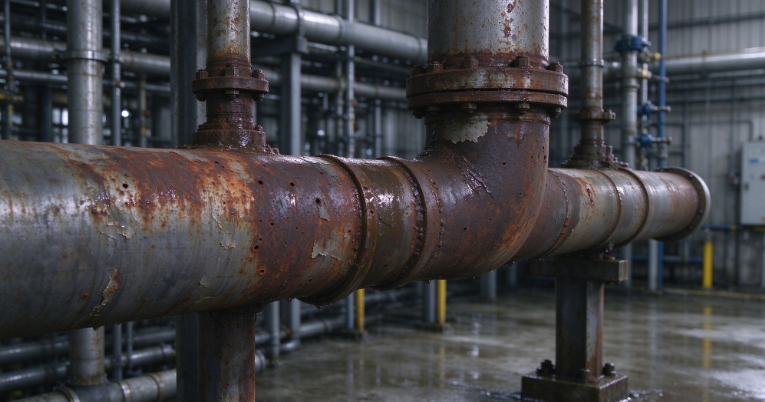
Production Process of ERW Steel Pipes
2026-05-28
Production Process of ERW Steel Pipes
What is ERW Pipe?
Short for high-frequency straight seam resistance welded steel pipe, ERW pipe is manufactured from hot-rolled steel coils. These raw materials are shaped into tubular blanks via professional forming equipment. By utilizing the skin effect and proximity effect of high-frequency electric current, the edges of the tube blanks are heated until molten, then firmly bonded together by squeeze rollers to complete welding. Globally, ERW products make up around 80% of the total production volume across all welded steel pipes.
ERW pipes are available in sizes ranging from 1/2 inch to 24 inches. Carbon steel variants mostly follow the ASTM A53 standard, while stainless steel types comply with ASTM A312. For dimensional design, ASME B36.10 and ASME B36.19 serve as the main guidelines, and API 5L is the dedicated standard for ERW welded pipelines.
In recent years, manufacturers have widely adopted advanced welding solutions including HFI and HFW high-frequency welding. Thanks to these upgrades, ERW pipe can now serve as a practical alternative to seamless pipes in both cost and overall performance. Such technological progress has narrowed the performance gap between the two products. They can even be used interchangeably under medium and low pressure as well as moderate temperature conditions. Even so, seamless steel pipes still hold an edge, since steel billets deliver better mechanical strength than steel coils and sheets.
What Is ERW Pipe Manufacturing Process?
To fully understand how is erw pipe made, it is essential to learn about its complete production workflow. ERW pipe production takes steel coils as the raw material, which undergoes a full series of procedures including uncoiling, cutting, fine processing, welding, and rigorous testing.

For oil and gas pipeline production, the most mainstream welding method is ERW-HFI (high-frequency induction technology). This process applies induction current to the pipe’s outer surface, creating a solid, sturdy weld seam that tightly bonds the two edges of the steel coil together.
Industry Standard Tips
ASTM A53 standard applies to both seamless and welded steel pipes with nominal wall thickness. These pipes commonly feature black steel or hot-dipped galvanized surfaces. Primarily designed for pressure-bearing and mechanical scenarios, ASTM A53 pipes are also widely used for steam, water, and natural gas transmission pipelines.
As classic American steel pipe specifications, ASTM A53 Grade B and API 5L Gr.B are widely adopted in the industry. To distinguish them simply: A53 GR.B ERW stands for electric resistance welded steel pipes that conform to the ASTM A53 Grade B standard, while API 5L GR.B Welded refers to welded steel pipes manufactured in line with the API 5L Gr.B standard.