
How to Use Steel Props in Construction from Assembly to Maintenance
2025-06-12
How to Use Steel Props in Construction from Assembly to Maintenance
In modern construction, steel props have become an essential component in temporary support systems, especially in tasks like formwork, excavation, and structural repairs. Unlike traditional wooden props that require cutting and can only be used once, adjustable steel props offer superior safety, flexibility, and reusability. These durable and eco-friendly supports play a critical role in shoring operations, helping to prevent collapses during building, demolition, or foundation work. Understanding how to use steel props correctly not only improves on-site efficiency but also ensures the safety and stability of surrounding structures.
Types and Components of Steel Props
Steel props generally fall into two categories: light-duty and heavy-duty types. Light type steel props are ideal for smaller-scale tasks and lighter loads, while heavy type steel props are designed to handle larger structural elements and higher weight demands. Both types are widely used on construction sites due to their adaptability and reliability.
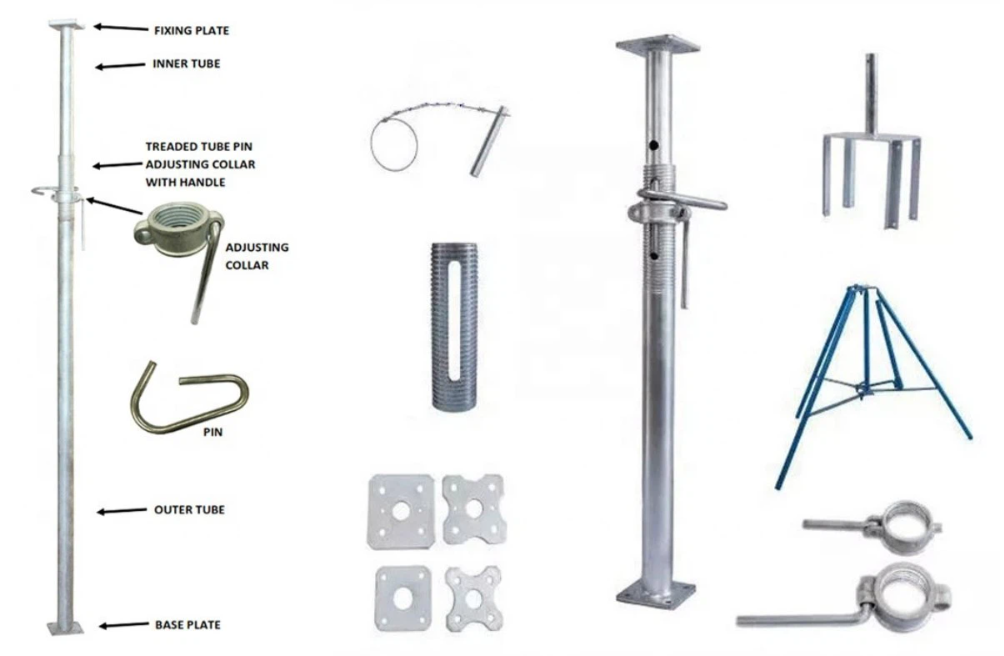
A typical adjustable steel shoring prop consists of the following key components:
Inner Tube: The movable section that allows the prop to extend to different heights. It features a row of holes for pin-based adjustments.
Outer Tube: This is the stationary sleeve that houses the inner tube and provides structural stability.
Base Plate: Located at the bottom, this flat plate distributes the load evenly and enhances ground stability.
U Head or Flat Head Plate: Positioned at the top of the prop, it supports beams, slabs, or other horizontal elements.
Adjustable Collar: A threaded collar that enables fine height adjustments for precise leveling during installation.
Regardless of type, learning how to use steel props starts with understanding their construction. Familiarity with each component helps ensure proper setup and safe application in various construction scenarios.
How to Assemble Steel Props Step by Step
Proper assembly is a critical part of understanding how to use steel props safely and effectively. Whether using light-duty or adjustable steel shoring props, following a systematic process ensures structural stability and worker safety on site.
1. Inspect the Steel Props
Before installation, thoroughly inspect each prop for any signs of damage, corrosion, bending, or wear. Do not use any prop that appears compromised—replace it immediately to avoid safety hazards.
2. Determine and Adjust the Required Length
Assess the height and load-bearing requirements of your structure. Most adjustable steel props feature telescopic tubes that can be extended or retracted. Set the prop to the approximate height needed for your application.
3. Secure the Base Plate on a Stable Surface
Place the base plate on solid, level ground. The plate should sit perpendicular to the applied load to maximize balance and support. Avoid using props on uneven or unstable foundations.
4. Align the Head Plate with the Load Point
Position the head plate—whether flat or U-shaped—directly under the element being supported, such as a slab or beam. Ensure full contact between the head plate and the structural surface to distribute the load evenly.
5. Fine-Tune the Height
Use the threaded collar or pin-lock system to make precise adjustments. Once you've reached the correct height, verify that the inner tube is locked securely into place and cannot shift during use.
6. Tighten All Locking Mechanisms
Secure all collars, nuts, or pins firmly. Double-check each locking point to prevent accidental movement or slippage during operation.
7. Respect Load Capacity and Apply Safety Margins
Always follow the manufacturer's load limits for each prop. Leave a safety buffer to accommodate potential shifts in weight or unplanned additional loads during construction activities.
8. Use Multiple Props for Even Support
Distribute multiple steel props at regular intervals to support larger or heavier structures. The spacing and quantity should match the structural dimensions and load requirements for optimal stability.