Hot Rolled vs Cold Rolled Steel | Key Differences You Should Know
2026-05-27
Hot Rolled vs Cold Rolled Steel | Key Differences You Should Know
The main difference between cold rolled steel and hot rolled steel lies in their distinct processing methods. Hot rolled steel and cold rolled steel are produced in completely different ways: hot rolled steel undergoes rolling under high temperatures, whereas cold rolled steel takes hot rolled steel as the base material and goes through additional cold reduction processing. After cooling down, the steel will be treated with annealing or temper rolling. Various steel grades and specifications can be manufactured via hot rolling or cold rolling techniques. Learning about the difference between cold rolled steel and hot rolled steel enables you to pick out the most suitable steel products for your projects.
What is Rolled Steel?
Steel rolling refers to feeding metal through one or multiple roller sets to flatten the material, reduce its thickness and make the overall dimension uniform. Most production lines adopt 3 to 6 pairs of rollers to gradually adjust steel thickness. The core purpose of rolling is to make steel meet standard dimensional requirements and achieve the proper thickness for practical use. A large part of rolled steel discussions focus on hot rolled vs cold rolled steel, and understanding the difference between cold rolled steel and hot rolled steel is the first step for material selection.
Hot Rolled vs Cold Rolled Steel
Hot Rolled Steel
As the name suggests, the most obvious distinction reflected in the difference between cold rolled steel and hot rolled steel lies in the processing temperature. Hot rolled steel is manufactured at temperatures above 1700°F. Steel starts to turn red at 900°F and undergoes recrystallization between 750°F and 1300°F, so it can be easily reshaped before hardening. This process demands less labor and mechanical force, cutting down production costs effectively.
Nevertheless, it also comes with drawbacks. Steel will shrink during the cooling phase, and the shrinkage range and direction are unpredictable, making it hard to control the final dimensions precisely. Besides, a flaky oxide scale will form on the surface of hot rolled steel. To obtain a clean surface, extra treatments like grinding, sandblasting or acid pickling are necessary. All these traits are key parts of the difference between cold rolled steel and hot rolled steel.
Cold Rolled Steel
Cold rolling is a follow-up process of hot rolling. After hot rolled steel cools down to room temperature, it will be reprocessed without reheating. This production flow is one major factor that creates the difference between cold rolled steel and hot rolled steel. To clearly tell apart cold rolled steel and hot rolled steel, you can start with their production flow. Without secondary heating and cooling shrinkage, cold rolled steel boasts outstanding dimensional accuracy and a sleek surface. What's more, its tensile strength and yield strength are about 25% higher than hot rolled steel, and the gap can reach 40% to 50% under certain conditions.
Despite these outstanding advantages, cold rolling has an obvious shortcoming: higher cost. The additional processing procedures mean more labor input, so its price is considerably higher than hot rolled steel. Cost gap is also a notable item when studying the difference between cold rolled steel and hot rolled steel.
The Key Difference Between Cold Rolled Steel and Hot Rolled Steel
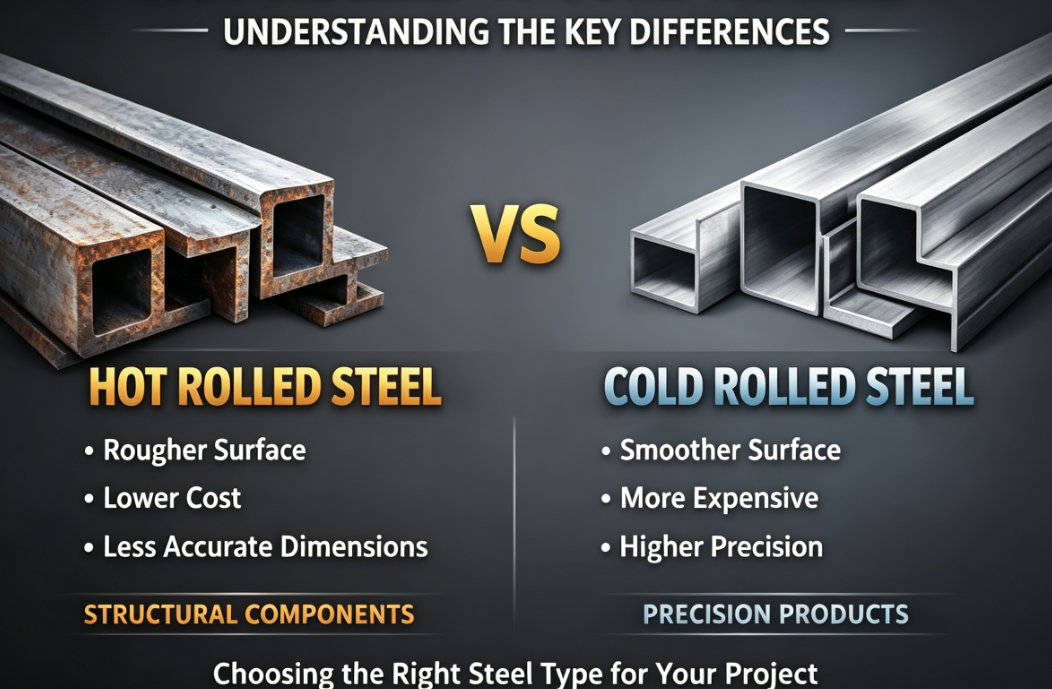
If you are still wondering about the core difference between cold rolled steel and hot rolled steel, we will make a clear summary here. Hot rolling delivers functional steel products with basic thickness and rough dimensions, while cold rolling adds extra processing steps to greatly improve dimensional tolerance, mechanical strength and surface finish. This is the most essential part of the difference between cold rolled steel and hot rolled steel.
It is worth noting that cold rolled steel is still susceptible to rust. Galvanization treatment after production is recommended to prevent oxidation. Considering the extra time and resources invested in cold rolling, it is naturally priced higher. When choosing between hot rolled vs cold rolled steel, you need to take the full difference between cold rolled steel and hot rolled steel into consideration.
Cold Drawn Steel vs Cold Rolled Steel
Similar to cold rolling, cold drawing is also a secondary processing technique applied to cooled hot rolled steel. The biggest difference is that cold drawing uses dies instead of rollers. The lubricated steel bars or wires are pulled through the funnel-shaped opening of dies to compress and reshape the material.