Can You Connect Galvanized Pipe to Stainless Steel? Everything You Need to Know
2025-04-24
Can You Connect Galvanized Pipe to Stainless Steel? Everything You Need to Know
In various industrial piping systems—ranging from structural supports to pressure vessels and exterior cladding—galvanized steel pipes and stainless steel pipes are often used in combination. However, can you connect galvanized pipe to stainless steel without risking long-term corrosion issues? Despite stainless steel’s excellent resistance to rust and oxidation, directly pairing it with galvanized steel in piping assemblies can sometimes lead to galvanic corrosion, especially in humid or saline environments. When these two dissimilar metal pipes come into contact, the zinc coating on the galvanized pipe may begin to degrade more rapidly, potentially compromising the durability of the entire piping system.
Can You Connect Galvanized Pipe to Stainless Steel? Understanding Galvanic Corrosion Risks
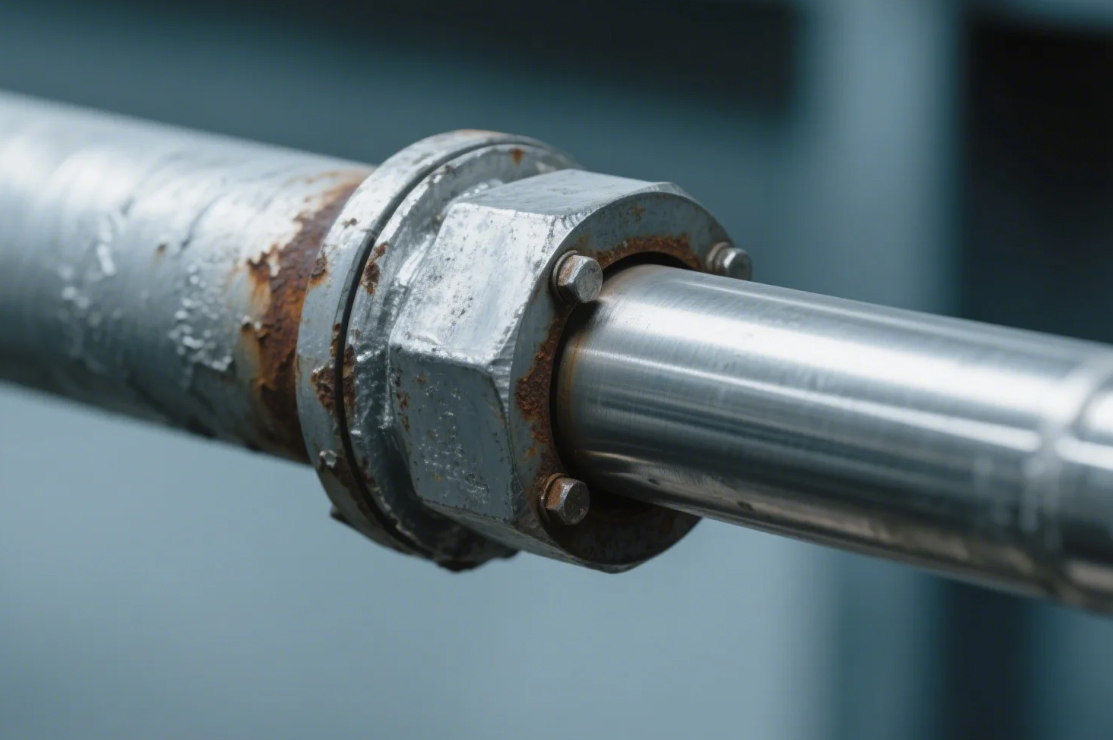
The core issue behind potential corrosion between stainless steel pipe and galvanized pipe lies in a process known as bimetallic, or galvanic, coupling. When different types of metal pipes are connected—especially in plumbing, industrial, or outdoor environments where moisture is present—a galvanic cell can form. In this setup, one pipe material acts as the anode and begins to corrode, while the other becomes the cathode and remains protected.
For galvanic corrosion to occur between a stainless steel pipe and a galvanized steel pipe, four conditions must be met:
The galvanized pipe (zinc-coated) serves as the anode, releasing electrons.
The stainless steel pipe acts as the cathode, receiving those electrons.
An electrolyte—typically water or moisture containing salts—must be present at the contact point, allowing ionic conduction between the two pipe surfaces.
There must be a return path for the current, which usually comes from the physical contact between the two connected pipes.
Stainless steel is a nobler metal (Cathodic) than Galvanised steel (Anodic). Galvanic corrosion will therefore occur in the less noble metal.
So, can you connect galvanized pipe to stainless steel safely? Only if these factors are properly managed. The galvanic series chart, like the one shown above, illustrates the relative nobility of metals—zinc being more anodic and prone to corrosion, while stainless steel sits lower on the chart and is less reactive.

Galvanic Corrosion Risks and Environmental Factors in Connecting Galvanized and Stainless Steel Pipes
When considering whether you can connect galvanized pipe to stainless steel, the answer isn't as straightforward as simply consulting a galvanic series chart. While such charts provide general guidance on metal reactivity, real-world pipe installations are influenced by environmental conditions and application methods.
Galvanized pipe features a zinc coating designed to shield the underlying steel from corrosion. However, when a galvanized steel pipe comes into direct contact with a more cathodic metal like stainless steel pipe, a galvanic reaction may form. In this scenario, the zinc sacrifices itself by corroding first—losing its ability to protect the base steel beneath. This defeats the purpose of galvanization altogether.
It's important to understand that a bimetallic couple only becomes active when four factors are present: two dissimilar metals (such as galvanized and stainless steel pipes), physical contact between them, an electrolyte (like water), and a conductive return path. Without a conductive liquid bridging the materials, the connection may remain stable.
In most dry or mild atmospheric settings, rain or dew—common potential electrolytes—are not very conductive due to their low salt content. Therefore, under these conditions, connecting galvanized pipe to stainless steel might not immediately result in corrosion. But in marine environments or areas with salty road runoff (like melting snow mixed with de-icing agents), electrolytic conductivity increases dramatically. In submerged applications, especially in saltwater, the risk of galvanic corrosion between galvanized and stainless steel pipes is significantly heightened.
To evaluate whether you can connect galvanized pipe to stainless steel safely in your specific setting, it's best to assess the environmental exposure and consider the conductivity of any present electrolytes.